- Define the intended user, care setting, patient population, and claims before selecting a device platform.
- Evaluate accuracy evidence, sensor design, display behavior, software controls, battery performance, and usability together.
- Require traceable quality records, incoming inspection, final testing, lot control, and complaint-handling procedures.
- Align labeling, packaging, language, regulatory documents, and export files with the destination market.
- Use pilot orders and acceptance criteria to reduce commercial risk before full-scale production.
For an OEM pulse oximeter project, the most important question is not simply whether a device displays oxygen saturation. It is whether the complete product system can support safe use, consistent manufacturing, market authorization, and brand-level service. The U.S. Food and Drug Administration explains that pulse oximeter readings have limitations and should be interpreted with symptoms and other clinical information, making validation and clear labeling essential.
What an OEM Pulse Oximeter Program Must Deliver
The core deliverable is a controlled medical device platform that can be adapted to the brand without weakening its safety, performance, or documentation.
Healthcare brands usually enter OEM sourcing with a desired product appearance, target price, and sales channel. A professional medical device OEM process starts earlier by defining the intended purpose. A device intended for home spot checks may require a different user interface and labeling strategy from a device intended for professional monitoring. The same hardware should not automatically be marketed for every clinical situation.
The intended-use definition should address the user, environment, patient group, measurement method, operating conditions, and claims. It should also identify whether the product is sold as a general wellness device, a medical device, or part of a broader monitoring system. These decisions affect verification, risk management, labeling, registration, and post-market obligations.
Typical OEM project stages
- Define intended use, claims, target markets, and commercial requirements.
- Review available device platforms and identify required customization.
- Complete design verification, usability review, risk analysis, and documentation planning.
- Run pilot production with agreed inspection and acceptance criteria.
- Finalize packaging, labeling, regulatory files, logistics, training, and after-sales procedures.
This staged approach prevents a common purchasing mistake: approving the appearance and sample performance before confirming whether the documentation can support the intended market.
How to Evaluate a Pulse Oximeter Manufacturer
The best supplier is the one that can connect engineering evidence with repeatable production and responsive service.
During supplier qualification, request objective evidence rather than broad statements about factory capability. Relevant evidence may include product specifications, verification summaries, risk-management records, component controls, calibration or test methods, batch records, packaging specifications, and complaint-handling procedures. The exact document set depends on the destination market and product classification.
Supplier evaluation should also cover the factory’s ability to control change. A display component, sensor, battery, enclosure, firmware version, or assembly method can affect the finished device. The brand should know how changes are approved, recorded, communicated, and evaluated before shipment.
| Procurement area | Evidence to request | Buyer scoring guide | Risk if omitted |
|---|---|---|---|
| Design control | Requirements, risk analysis, verification records | Score 1 to 5 | Unclear claims and weak change control |
| Production control | Work instructions, inspection records, traceability method | Score 1 to 5 | Variable quality between lots |
| Regulatory support | Technical files, declarations, labeling inputs | Score 1 to 5 | Registration or import delays |
| Service capability | Complaint process, spare-parts plan, response workflow | Score 1 to 5 | Slow resolution of field problems |
| Supply continuity | Approved component list and change-notification process | Score 1 to 5 | Unexpected redesign or stock disruption |
This scoring model is a procurement framework, not a clinical performance benchmark. A low score in a critical area should trigger a corrective action request before commercial approval.
Pulse Oximeter Accuracy, Limitations, and Clinical Context
Accuracy claims must be interpreted in relation to the test population, operating conditions, device configuration, and intended use.
Pulse oximeters estimate peripheral oxygen saturation and pulse rate through optical measurement. They do not directly measure arterial blood oxygen. Factors such as motion, poor circulation, skin temperature, nail products, sensor placement, ambient light, and other conditions can influence readings. The FDA’s safety communication on pulse oximeter accuracy and limitations explains why users should not rely on a reading in isolation.
For a healthcare brand, the practical implication is clear: do not reduce the product evaluation to a single displayed value. Ask how the supplier generated performance evidence, which populations and conditions were included, what exclusion criteria were used, and whether the evidence supports the exact configuration being sold.
The buyer should distinguish between engineering verification and clinical evidence. Engineering verification may confirm display behavior, alarm logic, electrical safety, battery operation, or mechanical durability. Clinical or performance validation addresses whether the measurement behavior is appropriate for the intended use and population. Both are important, but they answer different questions.
Clear instructions are part of product safety. The user manual should explain correct placement, the need to remain still, the meaning and limitations of the displayed values, and when the user should seek professional medical advice. The NCBI Bookshelf overview of pulse oximetry provides useful clinical background on measurement principles and interpretation.
Product Configuration and Customization Options
Customization should improve user fit and brand consistency without introducing uncontrolled technical changes.
Common OEM options include enclosure color, logo placement, screen layout, startup screen, language, packaging, carrying case, user manual, barcode format, and bundled accessories. Some projects also require software changes, connectivity, rechargeable power, protective covers, or a different sensor configuration. Each change should be assessed for its effect on performance, usability, labeling, and regulatory documentation.
| Customization level | Typical scope | Documentation impact | Commercial use |
|---|---|---|---|
| Level 1 | Logo, color, carton, manual language | Usually requires artwork and document review | Fast brand adaptation |
| Level 2 | Display layout, accessories, packaging configuration | Requires usability and configuration review | Channel-specific positioning |
| Level 3 | Firmware, enclosure, sensor, or electrical changes | May require additional verification and regulatory review | Strategic differentiation |
The table is a planning model rather than a universal regulatory classification. The supplier and the brand’s regulatory adviser should confirm the effect of each change in the destination market.
Quality Control for Medical Device OEM Production
Quality assurance is strongest when controls are built into every production stage instead of relying only on final inspection.
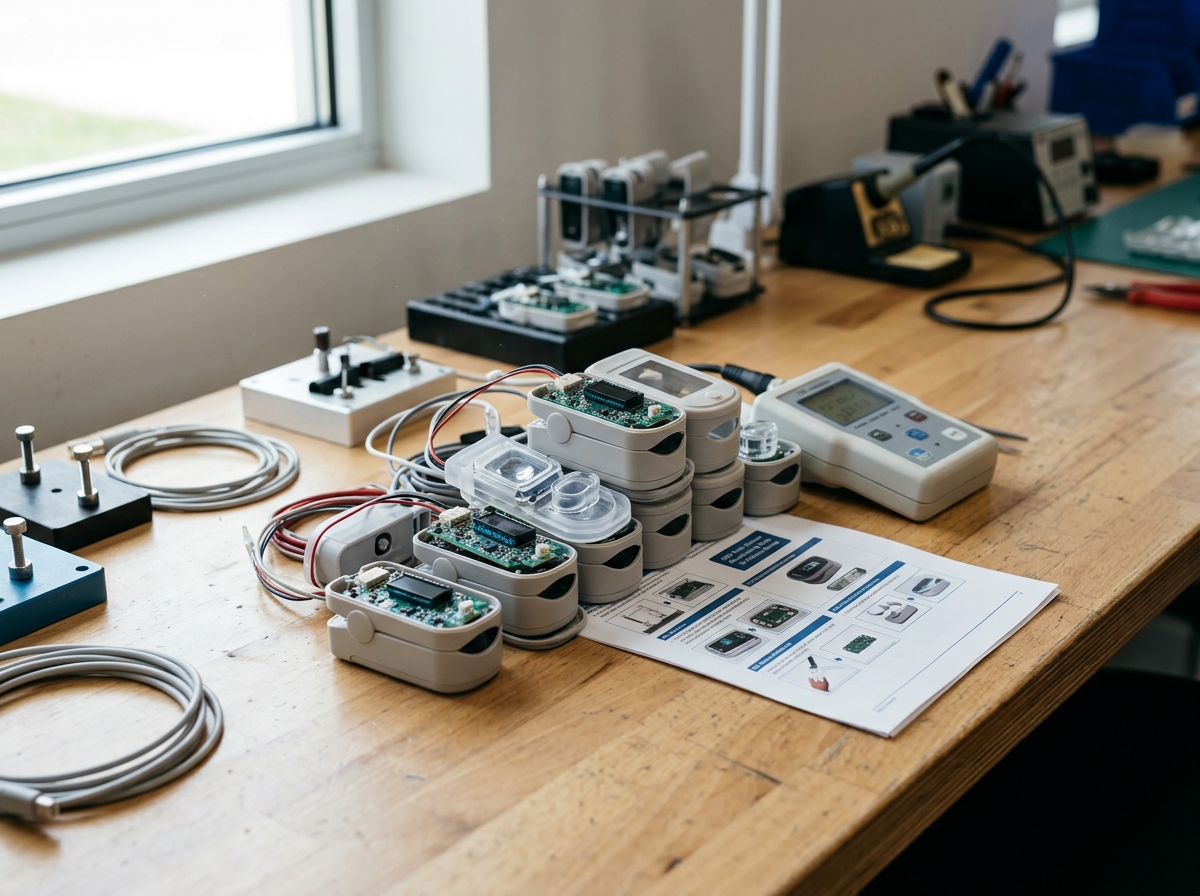
Incoming controls should cover critical electronic parts, sensors, displays, batteries, plastics, labels, and packaging materials. In-process controls should verify assembly steps that can affect measurement or reliability. Final inspection should include appearance, display operation, power behavior, labeling, accessories, packaging, and the applicable functional tests.
Traceability is particularly important for private-label medical devices. Each production lot should be connected to the relevant components, operators, inspection records, packaging version, and release decision. This allows the brand and supplier to investigate complaints without treating every shipment as an unknown population.
A practical acceptance plan should define the sample approach, test equipment, environmental conditions, defect categories, escalation rules, and responsibilities. It should also distinguish critical, major, and minor defects. A cosmetic issue may be handled differently from a missing warning, an incorrect label, or a device that fails its functional test.
Post-market support should be reviewed before the purchase order is issued. Ask who receives complaints, how incidents are escalated, how replacement units are controlled, how software or component changes are communicated, and how field trends are reviewed.
 Regulatory and Export Planning for Healthcare Brands
Regulatory planning should begin before the product name, claims, and packaging are finalized.
Requirements vary by jurisdiction and intended use. A supplier may provide technical documents, test reports, declarations, labels, and manufacturing information, but the brand remains responsible for confirming its legal obligations in each market. Buyers should establish who owns the product registration, who acts as the local representative when needed, and which party maintains the technical documentation.
Market-entry files commonly require consistent information across the product label, user manual, packaging, website, distributor materials, and customs documents. Inconsistencies can create avoidable delays even when the physical device is unchanged.
For international distribution, the sourcing package should cover commercial invoice data, packing information, country-of-origin requirements, product codes, shipping conditions, warranty terms, and language versions. The exact export documents depend on the route, customer, and destination rules.
The World Health Organization’s technical and training resource on pulse oximetry is useful background for teams developing education and clinical-use materials. It should complement, not replace, market-specific regulatory advice and product-specific evidence.
MOQ, Lead Time, Packaging, and Total Cost
Commercial terms should be evaluated as part of supply risk rather than as isolated price variables.
Ask the supplier to separate tooling, engineering changes, sample charges, packaging development, testing, registration support, freight assumptions, and recurring unit cost. Clarify whether the quoted price includes the requested accessory set, printed materials, labeling, and final inspection.
Lead time should be divided into development time, sample approval, material preparation, production, quality release, and shipping. A short factory production estimate does not necessarily mean a short end-to-end launch schedule.
MOQ should be reviewed against forecast uncertainty and product liability exposure. A lower initial quantity may support a controlled market test, while a larger run may improve packaging or component economics. The decision should account for shelf life, storage, demand visibility, and the cost of changing unsold inventory.
- Confirm whether the quoted MOQ applies per color, language, packaging version, or total order.
- Define the approval sample and identify who signs the final release.
- Agree on artwork ownership, revision control, and reprint responsibility.
- Set a written process for shortages, delays, nonconforming goods, and corrective actions.
- Review warranty duration, replacement policy, and technical support response expectations.
When an OEM Pulse Oximeter Is the Right Product Strategy
OEM sourcing is most suitable when a healthcare brand needs controlled customization, scalable production, and a documented supply relationship.
A distributor entering home-care channels may prioritize simple operation, multilingual packaging, compact logistics, and dependable replenishment. A hospital supplier may require stronger documentation, configuration control, training materials, and formal service procedures. An emergency procurement program may prioritize supply continuity, clear labeling, rapid deployment, and channel coordination.
In each scenario, the right product is defined by the use case rather than by the lowest quotation. A low-cost device can become expensive if it needs relabeling, fails market review, arrives with inconsistent accessories, or creates unresolved customer complaints.
OEM Pulse Oximeter Buyer Checklist
The following checklist helps buyers compare manufacturers before requesting a final quotation.
- Have the intended use and permitted claims been written clearly?
- Can the supplier identify the exact device configuration covered by its evidence?
- Are critical components controlled through approved suppliers and change procedures?
- Are production, inspection, release, and traceability records available for review?
- Can the supplier support destination-market labeling and technical documentation?
- Are packaging, language, barcode, accessory, and carton requirements documented?
- Is there a defined complaint, replacement, corrective-action, and communication process?
Requesting these answers early makes supplier comparison more objective and exposes hidden launch risks before they become purchase-order problems.
FAQ
What does OEM pulse oximeter manufacturing mean?
It means a manufacturer produces a pulse oximeter for another company under that company’s brand or commercial specification. The scope may include product selection, customization, packaging, documentation, production, testing, and after-sales support.
How do I choose a pulse oximeter manufacturer?
Compare design controls, performance evidence, production traceability, component management, regulatory support, customization control, supply continuity, and complaint handling. Price should be reviewed only after these risk areas are understood.
Can an OEM supplier customize the device?
Many suppliers can customize branding, color, packaging, languages, display presentation, accessories, and documentation. Firmware, sensor, enclosure, or electrical changes require a formal impact review because they may affect verification and market registration.
What technical documents should a healthcare brand request?
Request product specifications, intended-use information, risk documentation, verification summaries, test methods, labeling drafts, component controls, production records, inspection plans, declarations, and applicable market-entry documents. The required package varies by jurisdiction.
How should pulse oximeter readings be explained to consumers?
Instructions should explain correct placement, the need to remain still, factors that may affect readings, and the fact that a displayed value should not be interpreted without symptoms and other clinical information. Users should be directed to seek professional advice when appropriate.
What affects OEM pulse oximeter lead time?
Lead time depends on product selection, customization, artwork approval, testing, regulatory review, component availability, production capacity, inspection, and shipping. A written schedule should separate development, production, release, and logistics stages.
Should I start with a pilot order?
A pilot order is often useful when the brand is testing a new market, packaging version, accessory set, or distributor channel. Define acceptance criteria before production so the pilot generates actionable evidence rather than only a visual sample review.
About the Supplier
CILIANG serves international B2B buyers across medical consumables, healthcare equipment, and maternal and infant care products. Its stated capabilities cover research and development, production, sales, and service, supporting projects that require product coordination, private-label packaging, export communication, and after-sales follow-up. Buyers can use this type of integrated supplier model when building healthcare product portfolios, evaluating medical device OEM options, or preparing a structured inquiry for a new program.
For a product review or quotation request, provide the intended market, claims, target users, configuration, packaging needs, forecast, and documentation expectations so the supplier can respond with a more relevant proposal.

Post time: Sep-08-2026